AIBES 5-Point Friday #13
From multi-model orchestration to cybersecurity — here are 5 things our AI Business Engineers are excited about this week!
Signal Worth Noticing
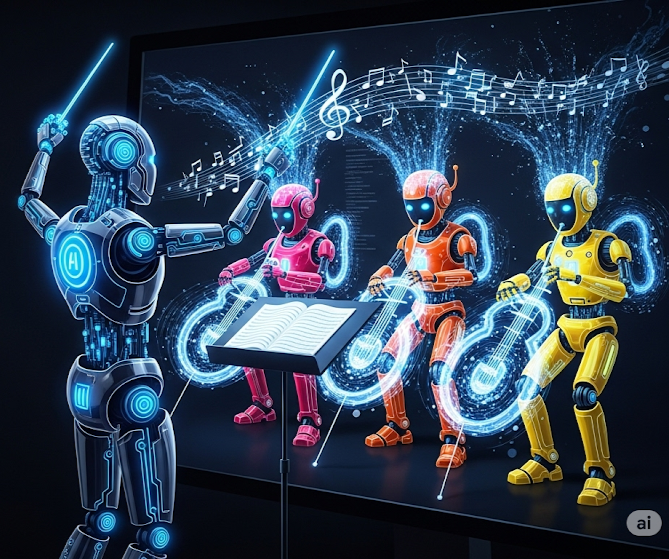
Products are beginning to deliberately orchestrate multiple models together. Microsoft’s latest “Critique” and “Council” capabilities inside Researcher make this explicit: instead of relying on a single model to generate an answer, systems are now designed to generate, challenge, and refine outputs across multiple models.
This changes the unit of value. It’s no longer “which model is best?” … it’s “what system produces the best outcome?” That pushes engineering effort into routing, arbitration, and verification layers rather than just model selection.
It also weakens the idea that you can pick a single model vendor and standardize around it. The emerging pattern is composability: different models for different roles, coordinated into a higher-order system. AIBES has been preaching model agnosticism since the beginning and several of our existing tools route several models together, already. How could your solutions benefit from a whole team instead of one MVP?
Framework We’re Using
The challenge with making AIRDEX locally hostable isn’t “can we containerize it?” — it’s “can we preserve the integrity of the product while changing where it runs?”
The right framing is to treat local hosting as a packaging strategy, not a separate product line. Same core platform. Same workflows. Same upgrade path. But with a simpler/different control plane, stricter dependency boundaries, and deployment that respects client control requirements.
What this forces – in a good way – is architectural discipline. Anything overly coupled, implicit, or fragile gets exposed the moment you try to hand the system to someone else to run. Our lead architect is especially good at planning for the future in these ways.
Local-hostability becomes a forcing function: if your platform can be cleanly packaged and operated without forking or degrading, you likely understand your own system at a much deeper level.

AIBES Tech of the Week
Custom slash commands fundamentally change how teams operationalize AI inside their development workflows. Instead of treating the model as a flexible but inconsistent prompt interface, you start treating it like a programmable layer of your tooling stack.
In Claude Code, slash commands allow us to define structured, reusable workflows that can encapsulate multi-step reasoning, tool usage, and constraints behind a simple invocation (e.g., /review-pr, /audit-schema, /prep-release). These commands can include scoped instructions, controlled tool access, arguments, and even references to files or prior outputs. That means we can design them to behave deterministically within a bounded context.
The real leverage shows up when you encode team-level patterns into these commands. Instead of every engineer reinventing how to run a migration check or validate a deployment, those processes become versioned, improvable primitives.
Trending News
Google its real-time voice and camera-based Search Live globally with Gemini 3.1 Flash Live
NVIDIA advances “power-flexible AI factories” with to align AI compute with real-world power constraints.
Anthropic accidentally leaked over 500,000 lines of Claude Code source code during a routine update, exposing internal architecture and unreleased features
OpenAI patched a critical Codex vulnerability that allowed attackers to inject commands via GitHub branch names and potentially compromise enterprise environments
- Caltech researchers unveiled a 1-bit AI model that compresses neural networks by up to 16× while maintaining performance, enabling high-quality AI to run on phones and drastically reduce energy usage


Quote We’re Pondering:
“A complex system that works is invariably found to have evolved from a simple system that worked.”
- John Gall — American author and systems theorist.